Pin It to Win It: How Pinterest Became the World's Largest Accidental Coven
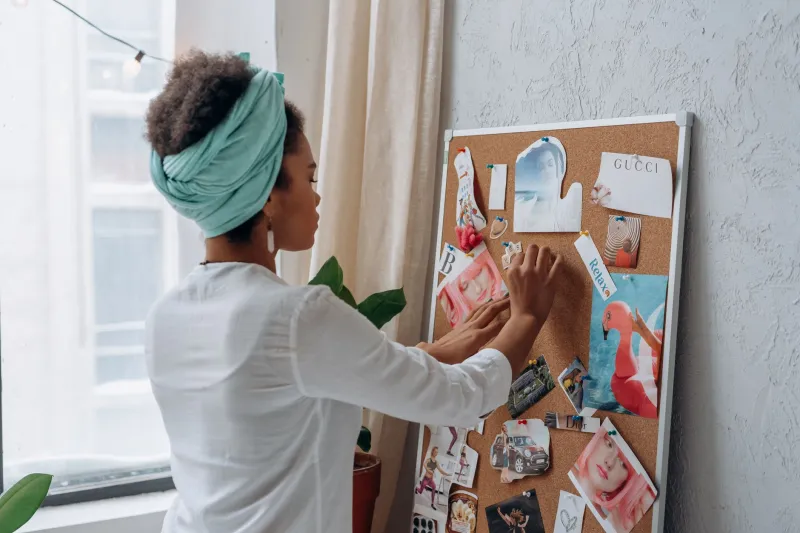
Let's say you spent a Tuesday night in your pajamas, quietly dragging photos of Tuscan villas, $12,000 handbags, and "morning routine aesthetic" pictures onto a digital board you titled something like My Future Life ✨. Totally normal. Totally harmless. You are simply a person with dreams and a Wi-Fi connection.
Or — and stay with us here — you just completed a ritual.
Because when you zoom out from the individual user and look at Pinterest as a whole, something genuinely strange is happening. Hundreds of millions of people are curating symbolic imagery, assigning it personal intention, organizing it into sacred categories, and then quietly trusting the universe to deliver. That is not a mood board. That is a grimoire. And Pinterest built the platform that hosts it, free of charge, with a cheerful red logo.
Welcome to the world's largest accidental coven. Population: your aunt who just discovered "soft life" boards.
What Even Is a Vision Board, Historically Speaking?
Before we drag Pinterest into a courtroom of cosmic accountability, let's acknowledge that vision boards didn't start with pastel fonts and Canva templates. The practice of assembling symbolic images to focus intention and attract desired outcomes is genuinely ancient. Egyptian tomb paintings were, in a very real sense, vision boards — curated collections of imagery depicting the life the deceased wished to manifest in the afterlife. Medieval alchemists kept illustrated journals crammed with symbolic diagrams meant to focus the mind and channel energy toward transformation.
In the 20th century, the concept got a glossy American rebrand via the self-help industrial complex. The Secret, published in 2006, turned manifestation into a national hobby. Oprah endorsed it. Book clubs dissected it. And somewhere in the cultural fallout, a generation of Americans learned that if you stare at a picture of something you want hard enough, the universe is legally obligated to provide it.
Pinterest launched in 2010. The timing, conspiratorially speaking, was impeccable.
The Board Is the Altar
Here's where things get genuinely interesting, or at least interesting enough that you should probably keep reading instead of going to bed.
In traditional occult and folk magic practice, an altar serves a very specific function: it's a physical space where symbolic objects are gathered and arranged to focus intention and signal desire to forces larger than the individual practitioner. You put things on the altar that represent what you want to call into your life. You arrange them with care. You return to them regularly. You believe, on some level, that the act of arrangement itself has power.
Now describe a Pinterest vision board without using different words. Go ahead. We'll wait.
The parallels are not subtle. Both involve the deliberate curation of symbols. Both are organized around personal desire and aspiration. Both require repeated engagement — you don't just make the altar once and forget it, you return, you adjust, you add new pins. And crucially, both operate on the assumption that the physical (or digital) act of organizing your intentions makes them more likely to manifest in reality.
The only real difference is that one of them has a browser extension.
The Algorithm as Oracle
If the board is the altar, then Pinterest's recommendation algorithm is the oracle — and it is disturbingly good at its job.
Anyone who has spent serious time on the platform has had the experience: you pin one image of a mid-century modern credenza, and within forty-eight hours your entire feed has transformed into a perfectly curated vision of a life you didn't know you wanted but now absolutely cannot stop thinking about. The algorithm doesn't just show you things you've searched for. It shows you things you were about to search for. Things you mentioned to your roommate. Things that exist only in the vague aspirational fog of your subconscious.
This is, technically, the result of sophisticated machine learning and behavioral data analysis. Technically.
But consider the user experience from the inside: you share your deepest desires with the platform, you arrange them into symbolic collections, and then the platform responds by showing you more of exactly what you secretly want. In any other context, we'd call that entity an oracle, a familiar spirit, or at minimum a very attentive deity. In this context, we call it a free app.
The manifestation community has noticed. Search "Pinterest algorithm manifesting" and you will find thousands of posts, videos, and comment threads from users who are entirely convinced that consistent engagement with their vision boards — pinning, re-pinning, returning, focusing — has preceded real-world results. New jobs. Relationships. That exact apartment. The algorithm, they believe, is not just reflecting their desires back at them. It is accelerating them.
Collective Ritual Without the Inconvenience of a Meeting
Here's the part that should probably concern someone with a philosophy degree: Pinterest users are not doing this alone.
At any given moment, thousands of people are pinning images to boards with nearly identical intentions. The "dream home" boards, the "vision board 2025" collections, the eerily similar assemblages of green juices, airplane windows, and stacks of cash with the word ABUNDANCE written over them in serif font. These boards overlap. They share images. They are algorithmically connected. Users are, without knowing it, participating in a synchronized group intention ritual with millions of strangers.
In ceremonial magic traditions, group rituals are considered significantly more powerful than solo practice. The combined focus of multiple practitioners, all directing energy toward a shared symbolic framework, is supposed to amplify the effect. Pinterest has essentially automated this process and made it aesthetically pleasing.
You're not just manifesting your dream kitchen. You're manifesting it in concert with forty thousand other people who pinned the same marble countertop image from Architectural Digest. That's not a mood board. That's a flash mob prayer circle.
Should You Be Worried?
Probably not, in the way you'd worry about, say, an actual cult with a compound and a charismatic leader who controls the food supply. Pinterest is not going to ask you to sign anything or give up your assets. The worst documented outcome of a vision board is that you become mildly obsessed with a home renovation aesthetic that exceeds your budget.
But there is something worth sitting with here. The manifestation board phenomenon — now a multi-billion dollar ecosystem of apps, journals, courses, and influencer content — has quietly built one of the most participatory belief systems in American cultural history. It has its own theology (the law of attraction), its own rituals (the board), its own community (the entire Pinterest ecosystem plus a robust TikTok subculture), and its own testimonials ("I pinned this exact house three years ago and now I own it").
It emerged not from a prophet or a founder or a charismatic leader, but from the intersection of a free image-sharing platform, a self-help publishing boom, and the universal human desire to feel like the future might cooperate with you if you just arrange the right pictures in the right order.
Which is either deeply comforting or deeply suspicious, depending on how long you've been on this website.
The Bottom Line
Pinterest did not set out to create a global manifestation cult. It set out to build a platform for saving recipes and home décor inspiration. But somewhere between the algorithm and the aspiration, it accidentally became the infrastructure for the largest synchronized intention ritual in human history.
The boards are the altars. The algorithm is the oracle. And every Tuesday night, in pajamas across America, millions of people are performing ancient magic with a browser extension and a dream.
We're not saying it works. We're not saying it doesn't. We're just saying that if you do get that Tuscan villa, you might want to leave a small offering for the recommendation engine that helped you get there.
A re-pin, at minimum. It's only polite.