Knead to Know Basis: How Pandemic Sourdough Became a Full-Blown Ancestor Cult With Gluten
Let's set the scene. It's April 2020. You have nowhere to go, nothing to do, and a bag of all-purpose flour you panic-bought from a Costco that smelled vaguely of existential dread. Then someone in a Facebook group — probably named something like The Sacred Crumb Collective — tells you that you don't just make sourdough. You inherit it. You steward it. You become its keeper.
And just like that, you were in a cult. A delicious, carb-forward, suspiciously organized cult.
The Starter: A Living God in a Mason Jar
Here's what nobody tells you before you Google "how to make sourdough starter": you are not baking bread. You are adopting a dependent. A living organism that requires twice-daily feedings, a stable temperature environment, and — according to the more enthusiastic corners of the internet — a name, a personality, and occasionally, a birth certificate.
People named their starters. Doughstoyevsky. Yeastus Christ. Fermentor of the Apocalypse. These weren't jokes. These were identities. Sourdough enthusiasts on Reddit's r/Sourdough began posting updates about their starters the way new parents post about infants — with photographs, milestone announcements, and thinly veiled anxiety about whether the "rise" was normal.
"She had a really rough week," one user wrote in a thread that received 847 upvotes. "I think the kitchen got too cold. I've been sleeping with her next to the radiator."
Her. The starter was a her. The radiator was a nursery.
The Lineage Problem (Or: Why Does Everyone Have a 200-Year-Old Starter?)
Here's where things get genuinely conspiratorial, and we at Conspiracy Guy Cult feel professionally obligated to point it out: during the spring of 2020, an absolutely improbable number of Americans suddenly discovered that they had access to sourdough starters that were allegedly decades — sometimes centuries — old.
Your coworker's grandmother had one from the Gold Rush era. Your neighbor's college roommate had one that supposedly crossed the Oregon Trail in a covered wagon. Someone on Etsy was selling "San Francisco starters from 1849" with the confidence of a man who had absolutely no way to verify that claim and absolutely no intention of trying.
The math does not math. The timelines do not time. And yet, nobody questioned it, because when you are seventeen days into lockdown and someone offers you a piece of living history to nurture in your kitchen, you take it. You take it and you name it Gerald and you love it unconditionally.
The starter lineage system — the practice of passing cultures down through "bread families" — is, when you squint at it sideways, a remarkably efficient recruitment mechanism. You receive a portion of someone's starter. You feed it. You grow it. Then you pass portions to other people, who feed it and grow it and pass it further. Within six weeks of lockdown, sourdough culture had achieved the geographic spread of a mid-tier pyramid scheme, except the product was bread and the commission was the spiritual satisfaction of being someone's yeast ancestor.
The Bread Family Tree: Cults Have Done This Before, Just Saying
Every established religion has a lineage mythology. Apostolic succession. Dharma transmission. The direct chain of spiritual authority passed from teacher to student, culture to culture, starter to starter.
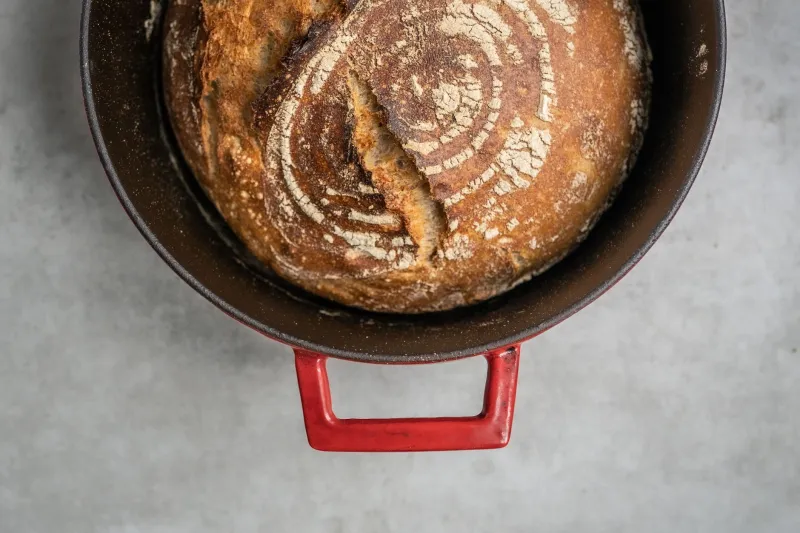
The sourdough community reinvented this wheel entirely by accident and then decorated it with a Dutch oven and a lame scoring tool.
Facebook groups organized around specific starter lineages began to emerge. Members would post photos of their loaves alongside documentation of their starter's "family tree" — who gave it to whom, how far back the line went, which famous baker or Instagram influencer sat at the top of the ancestral chain. There was status in having a well-sourced starter. A verified lineage. A starter that could be traced.
This is, historically speaking, exactly how cults establish legitimacy. You don't just believe in the thing. You believe in the unbroken line of people who believed in the thing before you.
The Devotional Routine: Fermentation as Spiritual Practice
We spoke to several committed sourdough practitioners about their maintenance routines. Their descriptions were, without exception, indistinguishable from religious observance.
"I feed Margot every morning at 6 AM and every evening at 6 PM," said one Denver-based enthusiast who asked to be identified only as "BreadDad_Colorado." "If I'm traveling, I arrange for someone to come over and feed her. I can't just leave her. She depends on me."
Another practitioner described the specific ritual of discarding a portion of the starter before each feeding — a practice the community calls, without apparent irony, "the discard." Some bakers use the discard for pancakes or crackers. Others simply dispose of it. Either way, the act of removing and sacrificing a portion of the living culture before renewing it with fresh flour and water is, structurally speaking, an offering.
We are not saying sourdough is a religion. We are saying that if you described the routine to someone without mentioning bread, they would assume you were describing a religion.
The Suspicious Timing of All of This
Let's zoom out for a moment, because this is a conspiracy site and we have a reputation to maintain.
In early 2020, millions of Americans were suddenly homebound, socially isolated, and desperate for community, purpose, and something to do with their hands. Into this vacuum arrived an activity that required daily ritual, produced visible results, connected practitioners to a global network of like-minded devotees, assigned them a role in a living lineage, and gave them something to care for when caring for themselves felt impossibly hard.
Sourdough didn't just fill kitchens. It filled the specific psychological gap left by the collapse of ordinary communal life. It gave people a reason to open an app, post a photo, receive validation, and feel connected to something larger than their four walls.
Was this by design? Probably not. Was it enormously convenient for the flour industry, which saw sales increase by over 600 percent in March 2020 alone? We're just asking questions. King Arthur Flour's website crashed. King Arthur Flour's website crashed. When was the last time a flour company's website crashed?
We're not saying King Arthur Flour engineered a global pandemic to drive sourdough adoption. We're saying it's suspicious that their website crashed and that their name is literally King Arthur, which is a legend about an unbroken royal lineage. Draw your own conclusions.
In Crust We Trust
The sourdough boom has faded somewhat from its 2020 peak, though the communities it built remain active, the starters it spawned continue to be fed, and the bread families it created are still passing cultures to new initiates who have no idea what they're getting into.
Somewhere right now, someone is explaining to a first-timer that their starter isn't ready yet — that it needs more time, more care, more patience — and that once it's ready, it will change their life. That the bread they make from it will taste different from any bread they've had before. That they'll understand, eventually, what all the fuss is about.
And the first-timer will nod, and take home their little jar, and name it something ridiculous, and feed it twice a day for the rest of their foreseeable future.
Welcome to the cult. The loaves are incredible.