Thirty-Two Ounces of Destiny: The Stanley Tumbler as Sacred Object, Status Relic, and the Thirst Trap That Ate a Generation
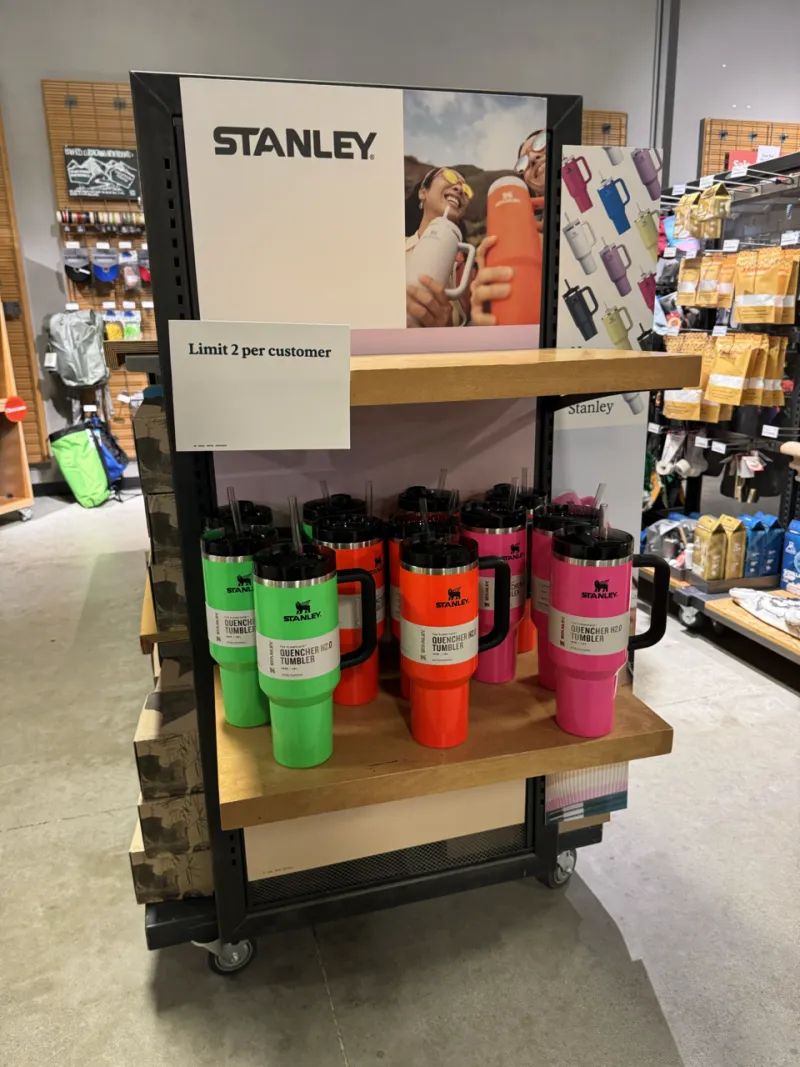
Photo: PK-WIKI, CC BY 4.0, via Wikimedia Commons
In the year of our Lord 2024, a woman in a Target parking lot in suburban Ohio reportedly arrived at 5:47 AM for a limited-edition Stanley tumbler drop. The store opened at 8. She brought a folding chair. She brought snacks. She brought, according to one witness, a positive attitude and a ranked list of her preferred colorways in case her first choice sold out.
She is not unusual. She is, in the taxonomy of the Stanley Cult, merely devout.
We have spent considerable time at Conspiracy Guy Cult investigating the mechanisms by which ordinary objects transcend their function and become identity infrastructure. The Roomba. Sourdough starter. Beanie Babies. Tupperware. Each of these, in their heyday, inspired a level of devotion that seemed disproportionate to the object's actual utility. But the Stanley tumbler — the H2.0 FlowState Quencher, forty dollars of double-walled stainless steel — may be the purest expression of this phenomenon we have ever encountered.
It is, to be completely clear, a cup. And yet.
A Brief and Suspicious Origin Story
The Stanley brand has existed since 1913, which is the kind of detail that seems irrelevant until you realize it means this company spent over a hundred years selling insulated containers to construction workers and hunters before suddenly, in 2022, becoming the centerpiece of a Gen Z status economy.
The pivot was not accidental. Stanley partnered with The Buy Guide, a shopping recommendation platform, and targeted a demographic that had never previously considered themselves in the market for a rugged work thermos. The result was one of the more remarkable brand resurrections in consumer goods history — a kind of corporate Lazarus moment that marketing professors will be teaching for decades.
But what nobody fully anticipated was what happened after the brand caught fire. Because Stanley didn't just sell a lot of cups. It accidentally created the conditions for a genuine collector culture — and collector cultures, as we have documented extensively, are basically just cults with better resale markets.
The Color Drop as Sacred Event
To understand the Stanley Cult, you must understand the color drop. This is the moment — announced with varying degrees of advance notice, sometimes days, sometimes hours — when a new limited-edition colorway becomes available for purchase.
Describing a color drop to a non-initiate is difficult. Imagine if the Catholic Church announced that a new shade of communion wafer would be available for forty-eight hours, limit two per person, and that owning it in the specific shade of Fog or Peach Tie-Dye or Winter Solstice would confer a measurable social benefit within your community. That is approximately the energy.
TikTok haul videos documenting successful color drop acquisitions regularly hit millions of views. Failed color drop attempts — arriving at Target to find empty shelves, the digital equivalent of showing up to the rapture a day late — generate their own grief-processing content ecosystem. People film themselves standing in front of barren Stanley displays with the energy of someone delivering news of a personal loss.
The scarcity is real, but it is also, clearly, managed. Limited runs create urgency. Urgency creates community. Community creates identity. Identity creates the kind of brand loyalty that no advertising budget can buy — because it is, functionally, a religious conversion.
The Secondary Market as Underground Temple
Where there are sacred objects and manufactured scarcity, there is, inevitably, a secondary market. And the Stanley secondary market is operating with the organizational sophistication of a small stock exchange.
Facebook groups, Discord servers, and dedicated subreddits have emerged as trading floors where discontinued colorways change hands at two, three, sometimes four times retail. A Quencher in a particularly coveted limited run — say, the Galentine's Day collaboration or a Starbucks exclusive — can command prices that make a forty-dollar cup feel like a quaint memory.
This is not unusual in collector culture. What is unusual is the earnestness with which participants describe the transaction. These are not people who acknowledge they are speculating on consumer goods. These are people who talk about finding a Cosmo Pink in the wild with the reverence of someone describing a chance encounter with a rare bird. The language is naturalistic, almost spiritual. The cup found them. They were meant to have it.
We have seen this pattern before. We wrote a whole piece about NFT Discord servers and mystery cults. The Stanley trading community is operating from the same psychological playbook, just with better hydration outcomes.
The Identity Architecture
Here is the part that elevates the Stanley phenomenon from mere collector culture into something that genuinely warrants the Conspiracy Guy Cult deep-dive treatment: the cup has become an identity document.
Your Stanley colorway communicates information. It signals your awareness of the drop calendar, your access to a Target or Starbucks at the right moment, your participation in the community that tracks these things. It signals disposable income, but not too much — the forty-dollar price point is aspirational without being exclusionary, which is an extremely sophisticated piece of social engineering whether Stanley intended it or not.
For younger consumers navigating a deeply anxious economic landscape, this matters more than it might appear. In a housing market that feels permanently closed, in an economy where traditional markers of adult success have been pushed beyond reach, a forty-dollar cup that signals membership in a desirable community is not frivolous. It is, in a very specific way, affordable belonging.
We are not being cynical about this. We are being genuinely sympathetic about it, which is unusual for us. The Stanley Cult is, in many ways, a completely rational response to an irrational economy. The cup is just the visible part of the iceberg.
The Cult Checklist
Let us run the numbers. The Stanley community has: a shared sacred object, check. Initiation rituals (the color drop hunt), check. Internal hierarchy based on collection depth and colorway rarity, check. Its own language ("HTF" for hard to find, "ISO" for in search of, the whole taxonomy of exclusives and collaborations), check. Grief rituals for failed acquisitions, check. Evangelism (the haul video, the gift-giving, the "you need one of these"), check.
Cult-O-Meter™ reading: 6.8 out of 10. Lower than manifestation TikTok, higher than your average brand loyalty program. Loses points for lack of doctrine. Gains points for the fact that at least everyone involved is genuinely drinking more water, which is more than we can say for most cults we've covered.
Stay hydrated, true believers. The next drop is coming.